Skip to content
TRESONANT.AI

DOC. TRS-002 — PLATFORM / CAPABILITY AREAS — REV 2026.08

The control system around the model.

Abstract

Models are components. Tresonant builds everything a regulated organisation needs around them: specification, evaluation, runtime constraint and evidence. Three capability areas, one architecture.


Area 01
AI reliability engineering — deterministic pipelines around probabilistic parts
§01
Area 02
Evaluation & guardrails — prove the boundary, then enforce it
§02
Area 03
Regulated deployment — shipped with the evidence attached
§03
Model coupling
Agnostic across all three areas; every component disclosed and approved
SPEC.05

Pick the claim you'd want proven · Industry scenarios →

§01

Deterministic pipelines around probabilistic parts.

A language model is not an architecture. We wrap probabilistic components in engineering that makes the whole system's behaviour specified, bounded and repeatable.

01.1 — What we build

Systems whose behaviour is written down before it is shipped.

Typed I/O contracts
Every model call has a schema; malformed output is a handled failure, not a surprise downstream.
Constrained generation
Structured decoding, allow-listed actions and bounded tool use, so the model can only do what the specification permits.
Deterministic orchestration
Control flow lives in reviewable code, with pinned model and prompt versions and reproducible configuration.
Failure budgets
Defined behaviour for timeouts, low-confidence outputs and rejected responses: retry, degrade or escalate to a human.
Change control
Prompts, policies and models are versioned artefacts; every change is diffable, reviewed and traceable to a release.
§02

Prove the boundary. Then enforce it.

Evaluation demonstrates that the system meets its specification; guardrails hold that specification against live traffic. We build both from the same source: your policies and your edge cases.

Fig. 05 — Evaluation loop: the suite is permanent, the gate is mandatory
SPECIFICATION POLICIES + EDGE CASES EVAL SUITE BEHAVIOURAL TESTS DEPLOY GATE PASS / FAIL / HOLD PROD GUARDRAILED SAMPLED PRODUCTION TRAFFIC → RE-EVALUATION

Schematic. Not to scale.

02.1 — Evaluation

Test suites derived from policy, not vibes.

Policy-derived assertions
Each clause of your operating policy becomes testable checks against real and synthetic cases.
Regression gates
Every prompt, model or policy change re-runs the full suite; regressions block release by default.
Adversarial suites
Prompt-injection, data-exfiltration and jailbreak batteries maintained as living test sets.
Calibrated grading
Automated grading is itself audited against human judgement on sampled cases, with disagreement tracked.

02.2 — Guardrails

Runtime enforcement of the same specification.

Input screening
Malformed, out-of-scope or adversarial inputs are rejected or quarantined before any model call.
Output verification
Schema validation, policy filters and consistency checks between model output and source data.
Bounded tool use
Models act only through allow-listed, permissioned tools with per-action audit records.
Mandatory escalation
Low-confidence or policy-adjacent outputs route to a named human owner; the system never quietly guesses.
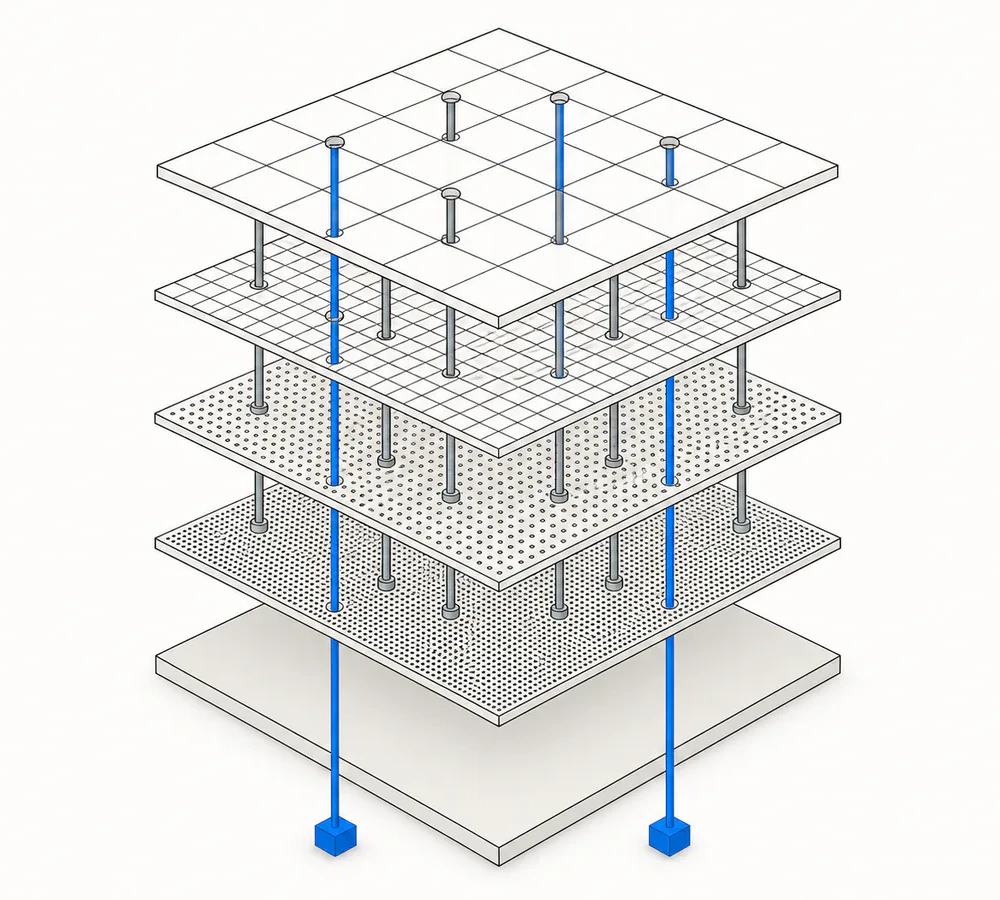
Fig. 06 — Guardrail strata (conceptual)
Isometric exploded diagram of five stacked filter planes of increasing density; most vertical paths are stopped at an intermediate layer while two blue paths pass cleanly through every layer and terminate in square nodes below.

Illustrative. Layer count and order are engagement-specific.

§03

Shipped with the evidence attached.

In a regulated organisation, deployment is not the end of engineering — it is a submission of evidence. We build systems whose controls can be inspected, and we write the documentation ourselves.

03.1 — Controls & evidence

Designed to survive an audit, not just a demo.

Decision-level audit trails
Inputs, versions, guardrail verdicts and human sign-offs recorded for every output, with a documented log schema.
Data-residency options
UK/EU deployment patterns, client-cloud and on-infrastructure delivery where obligations require it.
Human-in-the-loop checkpoints
Approval steps placed where accountability actually sits in your organisation, not bolted on afterwards.
Access & segregation
Least-privilege service boundaries; no shared credentials between environments.
Documentation packs
System descriptions, control mappings, evaluation reports and residual-risk statements written for risk committees and auditors.

03.2 — Deliberate exclusions

What we will not build.

No unaccountable autonomy
We do not ship systems that make regulated decisions without a named human owner and an escalation path.
No undisclosed components
Every model, vendor and sub-processor in the chain is disclosed to you and approved by you.
No training on your data
Client data is used only as your written instructions permit.

§04

Walk us through your architecture.

Bring the diagram you already have — whiteboard photo is fine. We will tell you where the verification layer belongs and what the evaluation suite should test first.

Pick the claim you'd want proven · Contact details →

sales@tresonant.co — we reply within one business day.